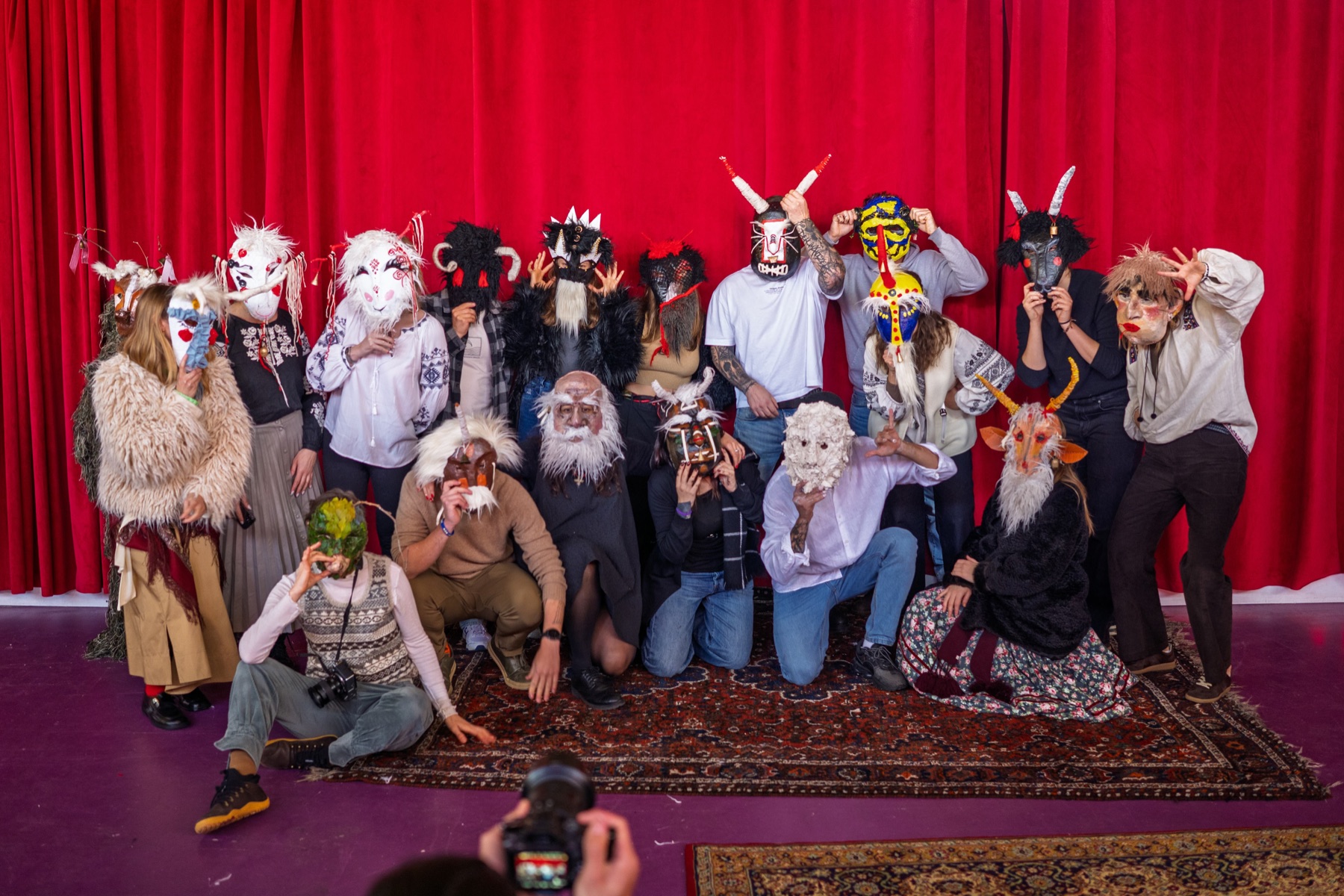
The collaboration between artists Veronika Prykhodko and VAS, and Kupala.UK returns with Malanka Fest—an expanded edition of the 2025 mask-making workshop.
Ukrainian solidarity collective Vsesvit joins the festival with a curated selection of zines and books. The programme also features performances by Hromada Collective and DJ Nick Guelder, and closes with UA TRIBAL, an audiovisual project by Ukrainian sound producer The Lazy Jesus and illustrator and visual artist Magister of Magic.
Artist moving-image works will screen in the Blue Room alongside the main-stage performances. Curated by Sofiya Marynyak, the film programme explores the Ukrainian landscape and life at the edges of urban ecology.
Film programme
edges of a ploughed land that you dissolve II (2026) · 10'15" · Sofiya Marynyak · @sofiya.marynyak
The series is centred around photos and videos taken while walking alongside and through various outskirts of Sofiya’s home region in Ukraine. The audio echoes between the clicks of the slides, is of a folk group’s singing (Hromada Collective). The fragments either mention gardens and rivers or are spring calling songs (Vesnianky). Coming in between is a slightly contradictory and antagonistic conversation between ruderal plants about roots, belonging, and going in circles. Sophia’s 2026 UCL graduation showcase page.
a steppe with rabbits and pheasants running around, and where some even saw foxes. part 2 (2020) · 10'25" · Daryna Mamaisur · @daryna.mamaisur · Sound design: Anna Khvyl
This video was created in the summer of 2020 during the Landscape As a Monument A-I-R Programme. The project's name quotes word-for-word from the Google Maps review (2018) of some industrial establishments in Ukraine. The online user Volodymyr Zhdanov comments about the plant in Mariupol: “The Azovstal is gradually turning into a steppe with rabbits and pheasants running around, and where some even saw foxes.” The first part consisted of photos and short essays, reflecting on the industrial landscape in Donbas and the symbolic order built around it. The second part, the video, takes a “step back” and focuses on the pre-industrial landscape and the ‘landscape in transition’. It was the late 19th-early 20th century when industrialisation gained momentum and changed the look of the region. For many witnesses, the rural, pristine and untouched fields/steppe were the subject of loss. The video includes fragments from the propagandist film “Perl of the Steppe” (1931), demonstrating the work of the scientific institute on ‘conquering’ steppe soil, and wild plants can be found only in the national reserves since then. In the past years, this narrative was more associated with the collapse of the industry. The video was an attempt to fantasise, to speculate on the flow of history represented in a landscape, to imagine the utopian scenario where the steppe returns to its lands. And to reflect on how loss looks back at us – as it accompanies us at every moment.
The video was filmed in the national reserve “Stone Tombs”, which is a one-hour ride from Mariupol. It is part of the Ukrainian Natural Steppe Reserve. In 2014, its biggest branch, called “Khomutiv Steppe” was occupied by the armed militants of the DNR (Donetsk People’s Republic). Under threats, its workers were forced to leave the reserve, so they had to continue their work in the other departments. These days, the “Stone Tombs” reserve is completely occupied, enduring the constant dangers of war. It is a tiny part of the technogenic and environmental disasters created by the Russian troops.
The video uses archive photos and excerpts from the “Perl of the Steppe” film (1931), which is stored in the Central State Film, Photo, and Sound Archive in Kyiv.
Salty Oscillations (2021) · 05'35" · ruïns collective · @ruins_collective
The work explores the influence of terrestrial and subterranean landscapes on imagination and the unconscious. Combining these documentary stories with contemplation of the terrestrial and underground landscapes that reflect the town's industrial past, this video tries to identify the influence of local lore mythology and geological features on the formation of identity and the idea of the “sublime”.
Endless Sea of Sand (2023) · 05'25 · ruïns collective · @ruins_collective
On March 4, 2022, the Russian troops occupied Zaporizhzhia Nuclear Power Station, the largest nuclear power plant in Europe. The day before they entered its satellite town, Enerhodar, and attacked resisting civilians who barricaded the road to the nuclear power plant. Founded in the early 1970s, Enerhodar (‘the energy gift’) was meant to serve the thermal power station and the nuclear power plant. Its construction was part of the Soviet modernist project championing industrialisation, urban growth and new nuclear technologies.
A few women (2026) · 7' · Svitlana Dovbush · @sveta_svetomuzyka
“And Where Now?” is set in a peculiar wartime landscape — in strategic locations that cannot be disclosed and along Ukraine’s eastern fronts, some of which, like Bakhmut, were completely destroyed shortly after filming.
Surrounded (2026) · 2'S0 · Svitlana Dovbush · @sveta_svetomuzyka
Svitlana’s graduation showcase page at UAL, 2026.
The screening will take place in the Blue Room, Proposition Studios, 279 Cambridge Heath Rd., Bethnal Green. This event is co-hosted with @kupala.uk and kindly supported by Proposition Studios. All profits will be donated to @ukrainecharityorg.